


Driving down Forest Road toward the covered bridge between Greenfield and Hancock, a little white Cape house sits close to the road. At first glance, the house would appear to date from the 1950s or 1960s, as it has been updated with new windows and vinyl siding. But owner Tom Merchant, who has lived in the house since he was five days old, says the house is lot older than it looks.
“It actually dates to the late 1700s,” he said. “When I was a child, my parents used to talk about the “hand-hewn beams” in the house, and they always said that showed how old the house really is. I never understood how they ‘hand-hewed’ the beams. Then my friend Dale Russell told me that although they are called hand-hewed, but weren’t really hand-hewed — they were logs that were split down the middle at the sawmill. I always wondered how did they make it so flat so they could nail the boards to it.”

The Greenfield Historical Society dates the house to around 1780, just four years after the signing of the Declaration of Independence. There is no record of who built the house, although it may have been members of the Holt family, who came to town around the same time, and were listed on the deed in 1866.
According to the Greenfield Historical Society, the age of the house is indicated by the hewn beam and peg (or “trunnel”) construction, which was used before nails were readily available. The Greenfield Meetinghouse, built in 1795, has the same trunnel and beam construction. The house also has original 14-inch plank floors dating from the 1700s.
“I don’t know why they weren’t 12-inch boards, but the whole floor was all 14-inch, which is strange, because they were usually either 10 or 12 inches,” Merchant said.
Over the garage, small antique windows are another hint of the home’s true age.
In 1780, Greenfield was still called the “Lyndeborough Addition.” In 1791, people living in the Lyndeborough Addition petitioned to found a new town, “Greenfield,” named for the town’s pastures and fields, as they felt they lived too far from the churches in Peterborough and Lyndeborough.
Merchant says that over the course of his life, “at least 100 people” have asked him why his house was built so close to Forest Road.
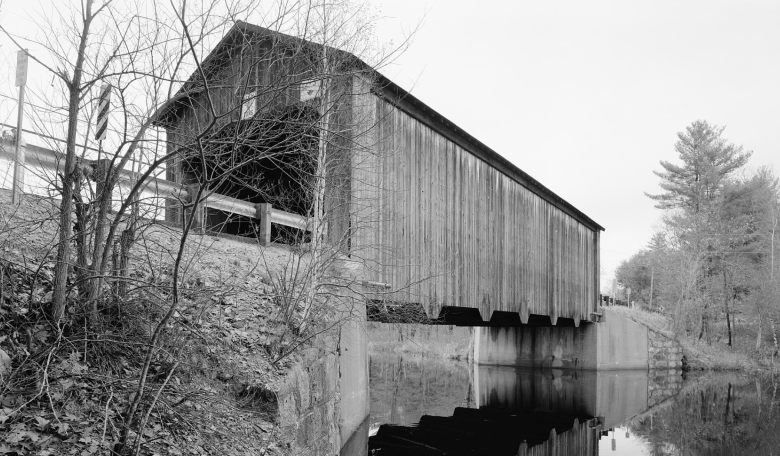
“Whenever people ask me that, I tell them the house wasn’t built close to the road. The road was built close to the house,” Merchant said. “The house was already here, and then they built Forest Road right up against it. Forest Road wasn’t built until 1852, and they built it right there, 50 or 75 feet away from the house, and then they built the covered bridge.”
Merchant, who worked for the town highway department in his youth, has extensive knowledge of Greenfield’s roads.
“Before they built Forest Road, the road to Hancock was actually County Road, after it crosses Old Bennington Road. Now, when you drive by there, it’s just a driveway that goes to the old farm, which used to be Carl Ingelstrom’s. There used to be a bridge over the river on that road, before the covered bridge was built,” Merchant said. “Working for the highway department, I got to know the roads in town pretty good. My job was walking and throwing rocks out of the road. When you walk the roads, you see more than most people driving by.”

Merchant has always been fascinated by the history of the house he grew up in, which has been home to many of Greenfield’s old families, including the Holts, the Sheas and the Ferrys. He remembers that one day, when he was a child, a carpenter who was doing repairs to the house discovered a sheaf of old papers hidden in the kitchen wall.
“The carpenter pulled them out of the wall and gave them to my mother, and they turned out to be all the old deeds of the house. We figured we had better hang on to them, because they must be important,” Merchant said. “They go back to the Civil War.”
The Merchants pored through the deeds, which traced the home’s history.
“The deeds are hard to read; it’s this beautiful handwriting, and people don’t write like that anymore,” Merchant said. “The deeds kind of show what a tough time it was after the Civil War, because while the house and land were sold for so many dollars, the sellers retained the rights to the vegetables in the garden — it specifies they would come back and pick the beans, the potatoes, and the squash. It also states that ‘the cordwood in the lane belongs to us,’ it did not go with the property when it was sold.”

Merchant recently donated the historic deeds to the Greenfield Historical Society. Sylvia Shea, a member of GHS, was especially interested in the deeds, as her late husband’s family, the Sheas, lived in the home for three generations.
“I always knew my husband’s grandfather lived in that house, but we don’t know much else about it,” Sylvia Shea said.

According “A History of Greenfield, N.H.,” written by Doris Hopkins for the Greenfield Historical Society in 1977, and “Greenfield’s Colorful Characters, ” published by GHS in 2023, the Shea family’s history in the Forest Road house is a tragic one.
In 1864, Thomas Shea and his wife, Kate, who had both immigrated from Ireland, welcomed their firstborn child, Frank. According to the handwritten deeds found in the wall, in 1866, Thomas Shea (formerly spelled “Shay”) bought the house from C.W. Holt. According to historic accounts, Kate and Thomas Shea soon parted ways. Thomas moved to Hancock, while Kate and her new husband, George Knight, stayed at the house.
By 1885, Kate, George, and five young children, including Frank, were living in the house. The couple had already lost an infant son, Elijah. Sometime that year, an outbreak of “black diphtheria” – a term for a particularly lethal strain of diphtheria that caused mucus membranes to appear black due to the presence of blood — broke out in Greenfield. The Knight’s four young children, Joseph, Freddie, Louis and Laura, all died in a matter of days. Kate and George buried their children alongside Elijah in the orchard behind the house.
Only Kate’s firstborn, Frank, survived.

Several years later, the Knights moved to a larger house on Slip Road, and moved the graves of the children to their new property, where a gravestone commemorates all five of the children they lost. Frank Shea, Kate’s only surviving child, later returned to the Forest Road house and raised his family there. Descendants of the first Frank Shea — including Greenfield’s Chief of Police, Frank Shea — still live in town and throughout the region.
Kate Knight went on to run a boarding house and become a well-respected businesswoman. Over the years, she bought up hundreds of acres in town, including 100 acres on Otter Lake, which later became part of Greenfield State Park. Although it was rare for women to own property at the time, Kate’s name is on the deeds of her property, indicating that she owned the land independently from her husband.
In 1945, Tom Merchant’s father, who grew up on Thomas Road in Greenfield, bought the Forest Road house from the Ferry family. After Merchant’s parents married, his mother went back to New Jersey for one year to earn money to help with repairs to the house, while his father stayed and set about creating the home his bride had asked for. Merchant remembers hearing stories about members of the Magoon family helping his father work on the house.
“My mother wanted a dining room, so my father put in the wall in the kitchen to create the dining room,” Merchant said. “It used to be one big room. And then my mother said she wanted a plaster wall, so my father put in one plaster wall.”
Merchant said his mother, who served on the Greenfield Select Board, “always loved the house and never wanted to change a thing.” The wallpaper and much of the furniture date back to Merchant’s childhood, and corner cabinets still hold Merchant’s mother’s collection of china and keepsakes.

Merchant says the sway-backed roof of the original house, another hint of the building’s age, has been that way since he was a child.
“I guess maybe that’s how it’s holding together, because it’s been like that since before the 1940s and hasn’t changed, and it doesn’t seem to do any harm, ” Merchant said.
The house is surrounded by stone walls, including the cellar hole of the original barn, which used to be on the north end of the lot. The orchard where the Knights first buried their five children has long since been swallowed by the woods.

Merchant loves “old-timey things,” and even installed a 19th-century-style stove in the parlor, which he keeps stocked with wood to heat the house.
“I like the way things used to be; I kind of like people who are from the last century, like me, ” he said. “I can heat my whole house with the wood. Why not have an old-fashioned stove for an old-fashioned house?”
Merchant’s biggest concession to modern times is the collection of small solar panels he installed himself to power his appliances and his computer.
“I spent a year putting up my solar panels and getting the electric panels for the house. That’s been my project the last few years,” Merchant said. “In the middle of the summer, on bright summer days, I can run the refrigerator 24/7 on solar. But in January, it doesn’t hardly pay to plug them in. The days are short, and it’s cold, and on those days, I have to plug in to Eversource.”
Merchant said he loves “not having to pay Eversource” for much of the year.
“It’s pretty nice to be self-sufficient,” he said.
