

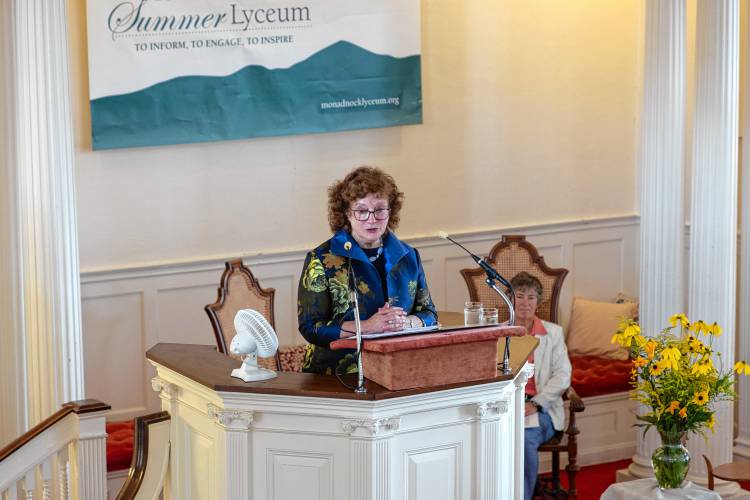
The history of small newspapers, as described by Penelope “Penny” Abernathy, is intrinsically tied to the history of the United States.
“From Revolutionary days to the present, local newspapers have been the glue that held our society and democracy together,” said Abernathy. “As pioneers moved west in the 19th century, one of the first orders of business right after they hired a Wyatt Earp to keep order was establishing a local newspaper.”
During the penultimate Monadnock Summer Lyceum event of the season Sunday, Abernathy presented “Can Our Democracy Thrive Without Local Journalism?” on the current climate for news publications, shrinking local papers and some good news for the future of the industry.
Abernathy, a longtime journalist at both local and national newspapers, opened with the story of the smallest publication to win the Pulitzer Prize for Public Service, The Whiteville News Reporter in North Carolina. The paper had a circulation of just 4,000 people in 1953, but was awarded the prize for coverage of the Ku Klux Klan in local government and law enforcement. Despite strikes from advertisers and personal threats, the findings led to 62 arrests across three years. The editor used the prize as a paperweight.
Les High, the grandson of the then-publisher of The News Reporter, had to sell the paper to the editor after his daughter chose not to carry on the family ownership. He then founded the Border Belt Independent, a nonprofit covering four of the poorest counties in North Carolina that relies on philanthropic grants to pay his two reporters.
Abernathy focused on the shrinking workforce within journalism, as well as publications shifting away from local news. She noted that the Pulitzer Prize for Public Service has been won by The New York Times, Associated Press or Washington Post covering international news. Smaller publications also have shrinking margins, with more than a quarter of the nation’s newspapers going out of business since 2005 and a third projected to be lost by 2025.
“When the lights go out at the newspaper, you no longer have the reporter at town board meetings, to say nothing of local festivals and personalities,” she said.
Abernathy went on to describe the dangers of “news deserts,” where there are no local outlets. In 1979, she said 33 percent of surveyed Americans could not name their local school superintendent. Now, 83 percent cannot even provide a guess.
Despite these statistics, Abernathy remains “increasingly optimistic” about the future of local journalism. Publications are adapting to the digital age, but she said citizens must do their part to stay vigilant.
“The fate of local news organizations and communities are inherently linked,” said Abernathy. “If one fails, the other suffers. All of us have a stake in nurturing a strong news environment.”
Hernan Romero will present “Romero Gets Personal: The Importance of Music in People’s Lives” at 11 a.m. on Sunday, Aug. 21, at Peterborough Unitarian Unitarian Universalist Church.