

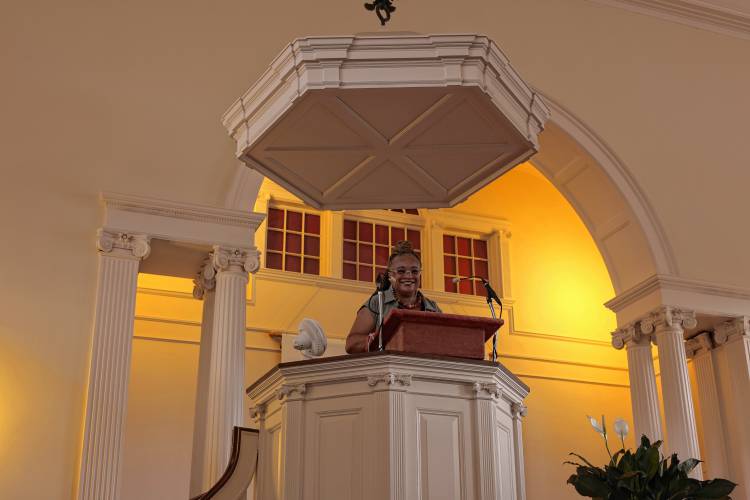
After a week off for MacDowell’s Medal Day, the Monadnock Summer Lyceum resumed Sunday with writer, educator and executive director of New Hampshire’s Black Heritage Trail JerriAnne Boggis, speaking about the widespread erasure of Black history in New Hampshire.
Boggis began her talk with a Nigerian folk tale, which she directly related to many facets of the Black experience in New Hampshire. In Nigerian folklore, the protagonist often is tormented or challenged by a lion. In the fable Boggis told, a young boy asks his father why the lion always loses despite being king of the jungle. His father responds, “The lion will win when he writes the story.”
Boggis went on to describe the Black experience in New Hampshire as a “microcosm of the whole country,” and continued to describe lesser-known instances of Black impact in the region that spanned over 400 years.
“I may be talking in circles,” said Boggis. “But I think circles bring us to the center.”
Her first instance involved a young Black man who moved to Milford and served as the town’s first veterinarian. Contemporary records have no indication of his presence, however, and name a different white man as the first vet in the town. In another instance, Malaga Island in Maine, a collective of the monetarily challenged as well as a largely Black population, was deemed a blight by the government and was entirely erased from the record and buried bodies were exhumed and moved.
A 1779 document published in Portsmouth was also brought into the discussion. Twenty slaves wrote an eloquent petition to abolish the practice that, according to Boggis, “rivals the American petition to the British for freedom.” She said the document has been largely expunged, likely due to its contradictions to then-common conceptions of the enslaved. Portsmouth was the second-most-active port to import kidnapped Africans, next to Newport, Rhode Island. This history was made apparent upon the recent discovery of a Black burial ground that had been concealed. Its documentation and exposure were largely headed by Boggis, a feat she referenced throughout the talk.
Another of the most-dramatic examples brought to light by Boggis was that of Noyes Academy. The academy was integrated in both gender and race, and was founded in Canaan in 1835. The school was a single building and was put in place by abolitionists from the region. It stood for a mere six months before being torn off its foundation by local farmers with 90 oxen, after which it was dumped in a bog and burned.
Boggis then emphasized the conflicting senses of perspective of being Black in New Hampshire, between the popular history and the truth.
“It creates a whole different image of what it means to be Black in New Hampshire,” said Boggis. “We have been here and continue to be here.”
After approximately 45 minutes, Boggis took questions from the audience, although a large stack of questions was left unread due to time constraints. Much of the discussion was centered around the recent alleged attempted lynching of a young boy by his classmates in Claremont, where Boggis and moderator Dottie Morris were both involved in the community response.
Boggis’ work at the Black Heritage Trail can be found at blackheritagetrail.nh.gov.
“We honor that story of a hero,” said Boggis. “Just to survive slavery is the story of a hero.”
The Monadnock Summer Lyceum will host Summer Lopez and her talk titled “The Freedom to Read: Why Banning Books Is a Threat to Democracy,” at 11 a.m. on Sunday, Aug. 6/