


Tucked away in Jaffrey Center, a stately white building sits in front of a sloping green lawn. Inside are decades of local history.
The former Melville Academy — now the Melville Academy Museum, owned by the Village Improvement Society — holds many aspects of Jaffrey’s past. On the first floor are town artifacts, including the former Jaffrey Center post office boxes, a collection of band boxes made by early woman entrepreneur Hannah Davis, and tools of everyday living.
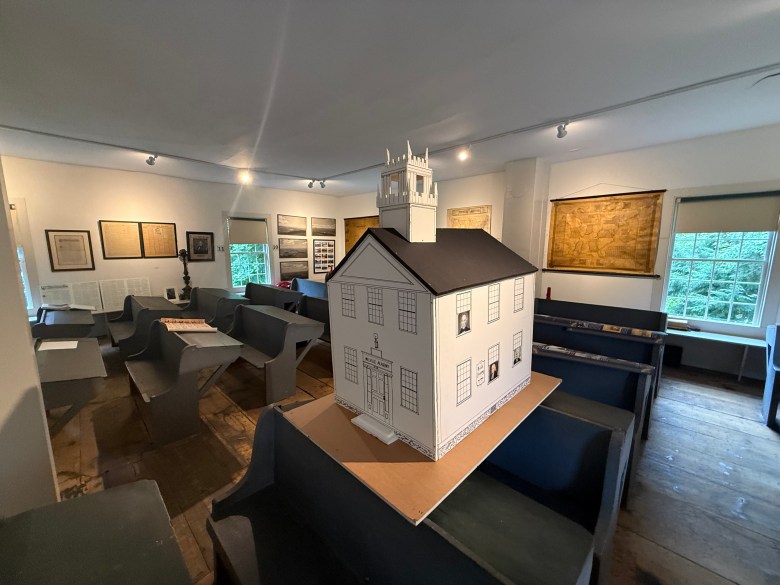
Upstairs, however, has been mostly dedicated to a recreation of an 1841 classroom, showing what school might have been like when the Melville Academy was still a school.
Sara Hamlen, a member of the Village Improvement Society, is one of the guides who host visitors at the museum every Saturday during the summer months. She said it’s fascinating to go through the old books and documents, and see what life was like for students almost a hundred years ago.
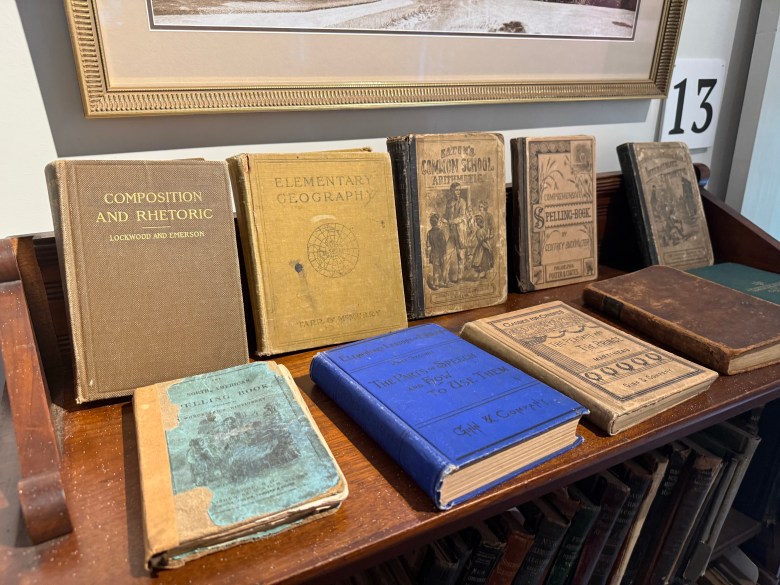
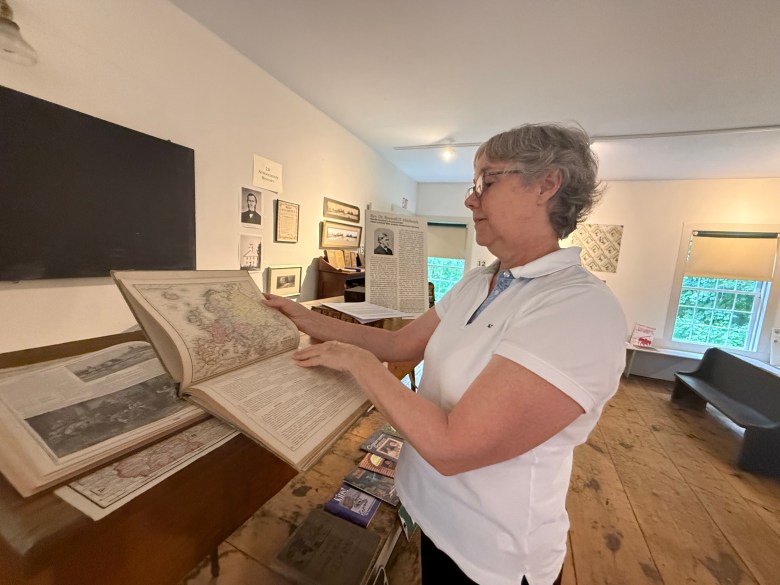
Small details reveal the sensibilities of the time. Hamlen flips open an arithmetic textbook and reads one of the word problems aloud:
“I intrust $10,000 to my factor in New Orleans for the purchase of cotton. What sum shall he invest after deducting .5% commission for the purchase, and what are his fees?”
Similar problems involve investing with a Boston broker to purchase bank notes and calculating a salesperson’s sales commission.
An 1877 geography book and atlas show the changing landscape of the world, with the United States still made up mostly of territories that would eventually become the western half of the country.
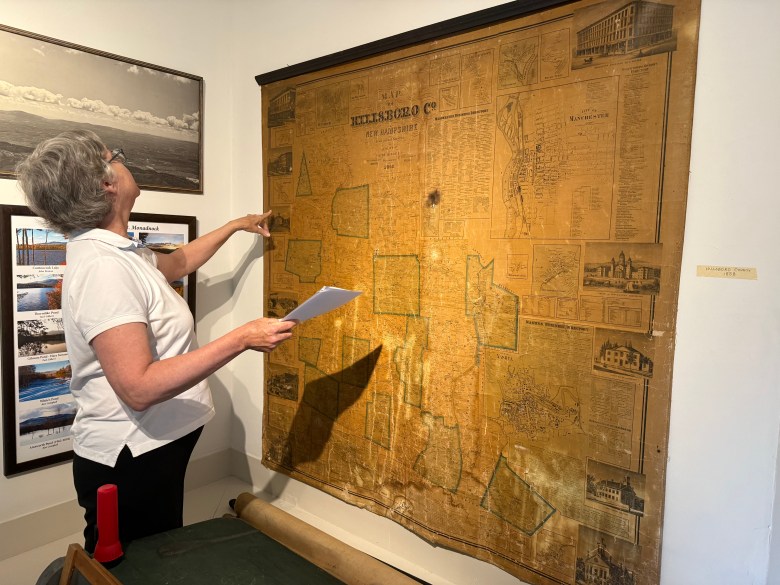
In addition to old instructional materials, the room itself is mainly filled with 28 mortise-and-tenon benches and desks, made by joiners and secured to the floor with joinery rather than nails or screws. At the front, the teacher’s desk is staffed by a manikin dressed in a period-appropriate dress. On the walls are maps of Cheshire and Hillsborough counties from 1858.
Framed documents on the walls around the room offer a glimpse of what life as an academy student might have been like, including a first-hand account written by Betsey F. Holt, who attended the Melville Academy in 1841.
Holt, who had seven siblings, was raised by her mother alone after the death of her father when she was seven. Originally from Troy, she moved to Jaffrey at the age of 13.
At the time, tuition for the Melville Academy’s 11-week term was $3.50. If a family wanted to include lessons in Latin and Greek, it was $4, and an additional $1 for French. Later documents show families could also pay extra for piano lessons and penmanship.
During her tenure at the school, Holt received awards for such accomplishments as “refraining from whispering” and “diligence and amiable behavior in school.” A job recommendation for a summer school teaching job, written for her by the 1842 Melville Academy Principal Henry Brickett, described her as “a young lady of good, moral character and good scholarship.”
An 1841 Melville Academy catalog describes the curriculum: A classical department and an English department. The classical department provides instruction in Latin, Greek, and French, and the English department, despite its name, provides instruction in arithmetic, grammar, geography, philosophy, chemistry, astronomy, algebra, surveying, rhetoric, history, botany, natural history, and weekly exercises in declamation and English composition.
The catalog boasts a “small library” of 100 volumes open to students, and the classroom’s wall maps for history and geography. Also, “Through the kindness of literary and scientific gentlemen in the vicinity,” there were lectures on “various subjects of interest and importance.”
Board, with “good families,” was also available near the academy for $1.33 per week, which included washing.
About the Melville Academy Museum
The Melville Academy was opened in 1833 as a private, co-educational high school. It was built by prominent Jaffrey banker Jonas Melville, for whom it is named, along with Dr. Luke Howe, Asa Parker, John Fox, who gave the land, and John Felt.
Before the academy’s opening, there had been multiple attempts to raise funds for it, said Hamlen, but some people objected that more education was a waste of time or might cause the town’s young people to become discontented with rural Jaffrey.
The academy thrived for some time, but after the depression of 1857, it closed due to dwindling enrollment numbers and financial problems. The town took possession of the building in 1863, and it was used for a time to teach students from School District No. 7, until the consolidation of schools around World War I.
In 1870, Conant High School was founded, and high school students met at the Melville Academy for the first year, while the Meeting House was being renovated. For a time, students alternated between the Jaffrey Center and East Jaffrey until 1897, when the high school was permanently based in East Jaffrey. The Melville Academy was last used as a school in 1918, and in 1920 the Village Improvement Society sought permission to use the building and renovated it as a museum.
Tours of the museum are available every Saturday from 2 p.m. to 4 p.m. through Labor Day.