


The United States makes up about 4% of the world’s population but generates roughly 12% of its trash — a distinction Duncan Watson, Keene’s former assistant public works director, called out with a wry “We’re number one” at Friday’s Amos Fortune Forum.
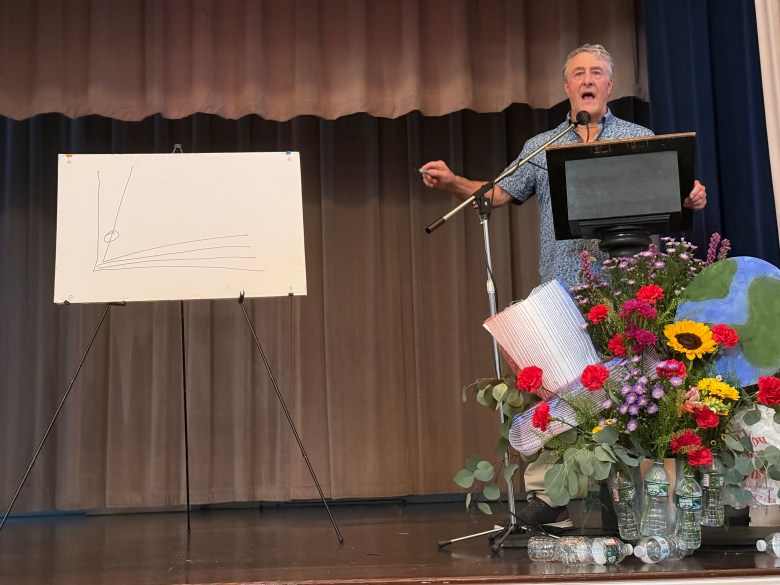
Watson was the most recent speaker at the Amos Fortune Forum on Friday evening, speaking on “Everyone’s Trash: Where We’ve Been, Where We Are, Where We Could Go.”
And trash is big business, Watson said, with trash disposal being upward of a $200 billion industry. He referred to the current system, in which increasingly consolidated companies are in charge of every step from trash collection to disposal, as the “800-pound gorilla” that can stand in the way of other options.
But, Watson said, the need for change is there. The state’s largest landfills are filling, and New Hampshire is accepting a large amount of trash from neighboring states. The toxicity of some items being regularly thrown away is higher, and items such as lithium batteries have caused fires at transfer stations, including five fires at the Keene transfer station during Watson’s tenure.
“There are consequences to our throw-away society,” Watson said.
One way to tackle the problem of diverting trash from landfills, Watson said, is infrastructure. In Keene, when he started at the public works department in 1992, the city was recycling at a rate of about 1% to 2%. In 1994, the city built a materials recovery facility with machine sorting.
Practically the day it came online, Watson said, that recycling percentage jumped to about 20%. But while it’s held steady, he said, that number hasn’t increased much since.
Watson said the current recycling model, in which citizens are relied upon to presort their trash, isn’t really working. A “one-bin” system, with infrastructure in place to sort recyclables after disposal, is the best way to make that leap in recycling, he said.
That technology exists and has been built in two facilities in Spain and Norway, Watson said, and could be implemented in the United States with more advanced processing facilities. It would take time, he said — even a shovel-ready project today would take at least three years to build — but could increase the amount of recycling diverted from landfills to as much as 80%.
Watson said private companies might be interested in building such facilities, which would take the cost off taxpayers, but would likely do so only if municipalities could guarantee a committed waste stream to the facility.
Three of these advanced facilities would be able to handle all of the state’s waste, Watson said. Conversations around such facilities are happening in pockets around the country, including in New Hampshire, but none are yet planned.
Watson said something needs to be done, adding that he views landfills as a “monument to failure,” with a huge amount of recyclable resources buried and capped every year.
That technology exists and has been built in two facilities in Spain and Norway, Watson said, and could be implemented in the United States with more advanced processing facilities. It would take time, he said — even a shovel-ready project today would take at least three years to build — but could increase the amount of recycling diverted from landfills to as much as 80%.
Watson said private companies might be interested in building such facilities, which would take the cost off taxpayers, but would likely do so only if municipalities could guarantee a committed waste stream to the facility.
Three of these advanced facilities would be able to handle all of the state’s waste, Watson said. Conversations around such facilities are happening in pockets around the country, including in New Hampshire, but none are yet planned.
Watson said something needs to be done, adding that he views landfills as a “monument to failure,” with a huge amount of recyclable resources buried and capped every year.
This Friday’s Amos Fortune Forum speaker is Marie Yovanovitch, in a talk titled “Insights on Ukraine: A Conversation with Ambassador Marie Yovanovitch.” Yovanovitch will share insights on the Russia-Ukraine conflict, drawing on her three years of service as U.S. ambassador to Ukraine from 2016 to 2019. The Amos Fortune Forum is held Friday evenings at 7 p.m. at the Jaffrey Meetinghouse and is free and open to the public.