

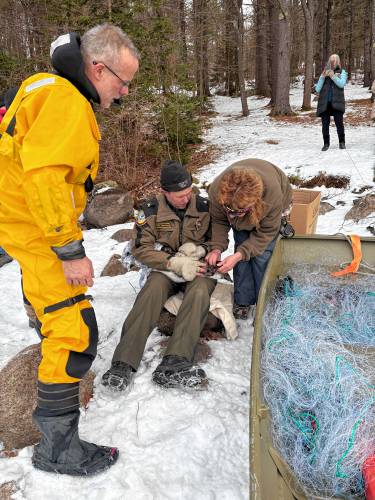
On Dec. 14 and 15, biologists from the Loon Preservation Committee rescued two iced-in common loons from Franklin Pierce Lake in Antrim and Weare Reservoir (Horace Lake).
Because loons have a high ratio of body weight to wing size, they need a long runway of open water — up to a quarter of a mile on a calm day — in order to take flight. Loons that have not left lakes by the time ice forms may become trapped, unable to take off without enough open water. Without intervention, iced-in loons are eventually forced onto the ice, where they are easy targets for predators such as eagles. If not preyed upon, iced-in loons face starvation or exposure to the elements.
Both rescued loons were examined, including blood tests and X-rays, to assess their health before being released. The Franklin Pierce Lake loon received overnight care at Wings Wildlife Rehabilitation Center before being released the following morning.The Weare Reservoir loon was released onto the ocean at Odiorne Point, a common wintering location for New England breeding loons, on the same day it was rescued.
Prior to release, each loon was banded with a unique combination of leg bands, enabling future identification if they return to New Hampshire lakes to breed. Most loons migrate to their ocean wintering grounds during the fall months.
“Local temperatures may influence the timing of migration for New Hampshire loons. If we have a warm October and November, some loons may remain on our lakes later than they normally would in order to take advantage of the open water and fishing opportunities. If they are caught off guard by sudden cold snaps, they may become iced-in,” stated Harry Vogel, senior biologist and executive director of the Loon Preservation Committee.
Members of the public are asked to call the Loon Preservation Committee at 603-476-5666 if they see loons confined to small patches of open water on freezing lakes. LPC urges the public not to attempt rescues themselves, as ice rescues can be dangerous without proper protective gear and training.