


Cynthia “Cyndee” McGuire, who has served as chief executive officer of Monadnock Community Hospital in Peterborough for the last 12 years, says there is never one day in her life that she has not been excited to get up and go to work.
“I love what I do. It’s just been such a gift and such a privilege to be able to serve people,” McGuire said. “I’m not sure if I will miss the work when I’m retired, but I will miss the people for sure.”
McGuire will retire from MCH in March, leaving a legacy of positive leadership and an ability to keep the hospital thriving despite numerous challenges in healthcare.
“I love what I do, but I just don’t have the capacity to do it anymore,” McGuire said. “This job requires you give 150%, 24/7. I’ve been here 12 years, and it’s time for change. It’s always nice to get new ideas and a different approach.”
McGuire is looking forward to spending more time with her husband, Harry, and their extended family, and moving full-time to the couple’s home near Saranac Lake in the Adirondacks.

“People ask me if I’m going to find another job, and the answer is ‘no.’ I’m going to spend some time on me, for at least one year. Since COVID, I haven’t had the time to even do things like walk outside every day,” McGuire said. “When the pandemic started, we all got on Zoom, and we were on it from 7 a.m. until 11 o’clock at night, every night. Ever since COVID, the team has had to wean itself off the habit of being in touch 27/7, even on the weekends.”
McGuire says healthcare in the U.S. has become increasingly challenging since the COVID pandemic, which brought an onslaught of new regulations and requirements.
“The last few years, since COVID, the work has changed. For healthcare, the regulatory environment, the way that we do our work, it just keeps coming; we just can’t get ahead of it anymore — there are regulatory changes, insurance, compliance, it is just constant, constant change,” McGuire said.

McGuire said she sees technology playing a larger and larger role in helping hospitals and healthcare providers stay on top of the ever-changing healthcare environment.
“We’re small, we don’t have enough people, and we’ll probably never have more people than we have now. We just have to move forward with using IT systems and technological advances that help us do the work we don’t have the people for anymore,” McGuire said. “That’s a big area of focus for us.”
McGuire says that while healthcare is not as advanced with technology as many other industries, she knows the field will catch up.
“We’ll get there, I’m excited for it, but I’m not quite ready for it myself,” she said. “Young people today are so efficient with using their technology, and it’s great, because it brings us all along.”

McGuire says another big challenge facing MCH and most hospitals in New Hampshire is the shortage of staff, which became more acute after COVID.
“We had a lot of people leaving healthcare. A lot of nurses didn’t want to be nurses anymore. We had five or six doctors retire; it’s required all of us to do more,” McGuire said.
In the years since COVID, MCH has been able to fill the positions of the doctors they lost, as well as adding physicians in gastroenterology, cardiology, and rheumatology.
According to McGuire, behavioral health care is particularly in crisis, with a shortage of providers across the state.
“It’s very hard when our patients need help, and there is nowhere for them to go, either inpatient or outpatient. It’s not uncommon for patients to be waiting in the ER for a week for behavioral health. We do our best to make them comfortable, but it is not a great situation,” McGuire said. “Those are big dilemmas that I feel frustrated that I can’t support our staff enough, and I can’t support the patients enough.”
Transport services are also at a critical point.
“The transport services don’t have enough staff, and they can’t hire people, and that’s true all over the country,” McGuire said. “It’s very hard on the staff as well when they have a patient and they know that patient needs something, and they can’t get them what they need.”

McGuire says the reason for the physician shortage is complex.
“No one has their own practice anymore. Doctors used to come in and care for their own patients at the hospitals in the mornings and in the evenings. Now, we have hospital-based physicians, and it’s kind of a fragmented system that we have. I’m old school; I remember when there used to be mostly nurses in the hospital during the day,” McGuire said. “Now we have fewer and fewer people going into primary care, and fewer people going into nursing.”
McGuire, who grew up in the Mohawk Valley region of upstate New York, has worked in healthcare for nearly 50 years. She volunteered as a Candy Striper in high school, which was her first experience with patient care.
“We got to go to patient rooms, we got to bring people pitchers of water and magazines, and I liked it,” she said. “My mom was in the Hospital Auxiliary, and back then, the ladies in the Auxiliary actually cooked the food for the cafe — they would make a casserole every day. It was so much simpler then. I worked at the front desk, and we had a card catalogue; we had paper records.”
After graduating from high school, McGuire, who grew up with “a strong Christian background,” enrolled in a Bible college.
“I thought I would do missionary work; a lot of my family did missionary work. But looking back on my life, I guess I did have a mission; it was always to serve people,” McGuire reflected. “I was always interested in the idea of service to others.”
Unsure what she wanted to do, McGuire left college after one year and went to work in a six-person pediatric practice as a medical assistant.
“I just loved the patients,” she said.
McGuire tried working in other industries, but she was drawn back to healthcare.
“Back then, women had three options: you could be a secretary, you could be a teacher, or you could be a nurse,” she said. “My husband always encouraged me to do more; he always said I had this great potential.”
MacGuire’s next job in the field was as a medical transcriptionist.
“I found I just loved the terminology, I loved learning about all of it, so I decided to go back and finish my bachelor’s degree. I thought about being a doctor or a nurse, but I realized I could not handle the blood and the bodily fluids, so I went the administration route,” she said.
McGuire earned both her B.S. and M.S. while working at Clare’s Hospital in Schenectady, NY., where she stayed for 29 years. She credits the CEO of the hospital with inspiring her to leadership.
“That CEO was out talking to the staff every day, he was on the patient floors — he had an expectation that all of us would be involved in the community; he showed up for everything,” she said. “He was really my inspiration.”
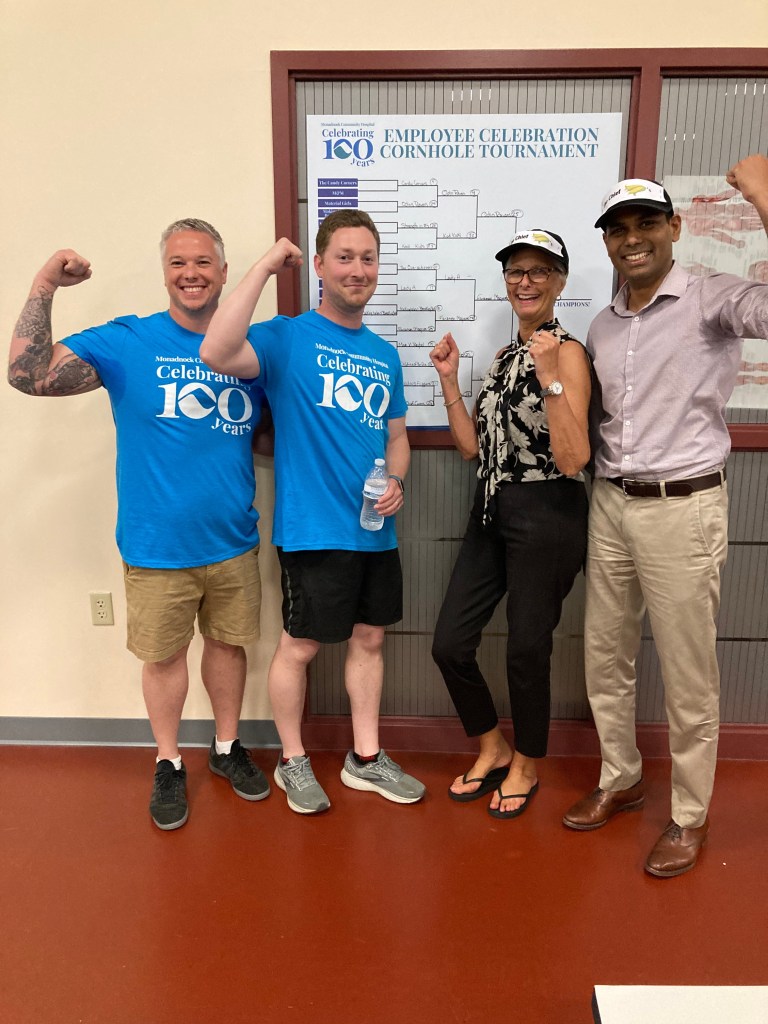

McGuire said one secret to her leadership success is that she “never says no.”
“I always tell my staff, say ‘yes’ to every opportunity; always say ‘yes.’ I always say, ‘Ok, I’ll try it,'” she said.
McGuire said MCH has been a perfect fit for her approach to leadership, and she has also been very impressed with the New Hampshire healthcare scene.
“When I came to New Hampshire, there were 10 female hospital CEOs, which knocked my socks off. New Hampshire is unique in that sense,” she said.
While serving as chair of the New Hampshire Hospital Association board, McGuire founded a Women’s Leadership Group for female CEO’s.
“My staff and my patients inspire me. If I’ve been stuck at my desk for a while, I get up and walk around and interact with people; it grounds me,” she said. “My personal mission has always been to help people. I said, back when I was starting in the field: if I help just one person a day, that’s enough. Now, I support my staff to help people. My job is to make sure people have what they need. Nobody wants to come to the hospital; it’s a pretty scary place to be. Our job is to make people as comfortable as possible. If we make decisions based on what is right for the patient, we will always make the right decision. And that, I will miss.
Correction: This story has been updated to reflect the correct spelling of Monadnock Community Hospital Chief Executive Officer Cynthia McGuire’s surname. We regret the error.