

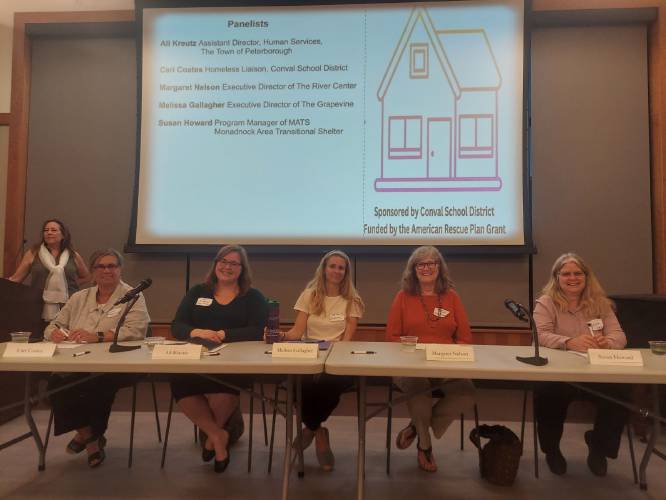
Monday evening, more than 50 community members, social service providers, invited guests and ConVal School District employees gathered at Peterborough Town Library for “Before A Challenge Becomes a Crisis,” highlighting the plight of young people in the district who are homeless or facing homelessness.
Conval Superintendent Kimberly Rizzo Saunders opened the evening by highlighting the importance of the federal McKinney-Vento Act, a 1987 law that provides services and supports for children in the district facing housing insecurity.
Salem State professor Yvonne Vissing, author of “Out of Sight, Out of Mind, Homelessness in Children and Families in Small-Town America” and co-author of “Changing the Paradigm of Homelessness,” was the keynote speaker.
Vissing addressed the causes and challenges of people facing housing insecurity, and encouraged the audience to rethink their ideas of who is homeless and what homelessness looks like. She spoke about the invisible nature of homelessness in communities like those in the ConVal district and other small communities.
The focus of Vissing’s books is on the families in small towns who are homeless but not seen, leading communities to believe there is no homelessness in their town. When this is the prevailing belief, then communities are slow or reluctant to take action to combat homelessness.
A panel of local service providers spoke after Vissing. They included Monadnock Area Transitional Shelter Program Manager Susan Howard, Conval School District Director of Student Services Cari Christian-Coates, Peterborough Assistant Director of Human Services Ali Kreutz, The Grapevine Executive Director Melissa Gallagher and River Center Executive Director Margaret Nelson.
Each member of the panel works directly with homeless families in the region, and spoke about the role they play in assisting families and collaborating with each other and other service providers to try and find housing for families who become homeless.
Christian-Coates, the district’s McKinney-Vento liaison, works primarily with students when the district finds out a family is homeless. She assists the family in accessing resources and ensures that the student is able to continue to attend school by coordinating transportation and other services. This support can be crucial to a student’s continued success in school.
Kruetz sees families who are facing eviction or who have lost their housing. Every town has a legal obligation to help assist families by providing financial supports if appropriate and referring families to services. The town can provide other financial assistance in emergencies that could help a family avoid homelessness.
Gallagher spoke about the role that The Grapevine plays in assisting families in Antrim, Bennington, Hancock and Francestown. The resource center can aid families with some financial assistance and also provides hands-on resource and service access.
Nelson described The River Center as “the place to go when you don’t know where to go.” Like The Grapevine, The River Center provides some financial assistance, and Community Resource Specialist Mandy Carter can help families access appropriate resources and services. Nelson recounted that just before she came to the event, an older woman came into the center very upset and in need of housing.
Howard spoke about the difficulties Monadnock Area Transitional Shelter has had in this housing market. She indicated that it has become harder to find permanent housing for the shelter residents, as a process that used to take three or four months is now taking closer to a year. There is currently a waitlist for the transitional shelter.
Howard noted that MATS is not an emergency shelter and that if she gets calls for emergency shelter, she will try and connect a family with the resources they need.
All of the panelists identified their agencies as good first phone calls if a family was facing homelessness or housing insecurity.
During the question-and-answer period, Pam Russell Slack, U.S. Sen. Jeanne Shaheen’s senior special assistant for constituent services, spoke briefly about financial assistance that was available for homeowners if they were unable to pay their mortgages. The program is accessed through the New Hampshire Housing Finance Authority.
The evening ended with a conversation on different issues facing service providers working with the homeless population in the region and the lack of community awareness of the issue. The recurring theme was that the stereotype of a homeless person sleeping on the streets was not the reality of the families or individuals facing homelessness in the region. Homelessness includes families sleeping in cars, in campgrounds, couch-surfing from one relative to another, doubling up with other families or splitting families up to stay with friends or relatives.
The issue of a lack of rental housing and the cost of rental housing was also repeated by both the speakers and those in the audience.