

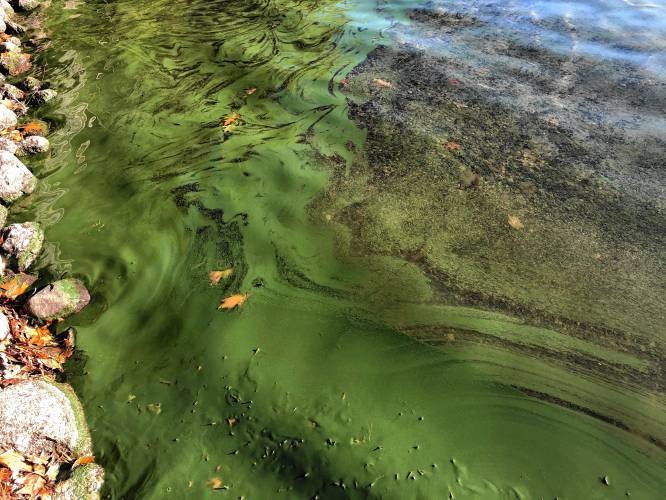
The Antrim Recreation Department posted an advisory last week warning of potential dangers cyanobacteria can pose to swimmers, dogs and livestock after after a bloom was observed on Gregg Lake in Antrim.
Recreation Director Celeste Lunetta spotted the bloom last Monday, June 19, and took a sample, which she brought to the New Hampshire Department of Environmental Services in Concord, where it was tested and determined to be of the genus Dolichospermum measuring at levels up to 134,600 cells per milliliter. An advisory is issued at levels exceeding 70,000 cells per milliliter. The advisory stated: “The advisory is not based on a toxin evaluation and is intended as a precautionary measure for short-term exposure.”
“Cyanobacteria is always there in every water body,” Lunetta said. It’s a natural phenomenon that is usually harmless, but when it blooms, certain cyanobacteria may release toxins, some of which are irritating to the skin, while others have the potential to cause liver damage and some are neurotoxins. Cytotoxins can be especially dangerous to dogs and livestock that drink from a bloom.
Gregg Lake had a cyanobacteria bloom last fall on the south side of the lake. This year’s bloom is in the area of the boat launch on the northern side.
“This is the first time a bloom on the beach is interrupting the beach season,” said Lunetta, “The wind has really been pushing the bloom into the beach shore.” Blooms can come and go quickly. By Thursday, the lake looked clear, but on Friday Lunetta reported patches of a bloom near the beach again. She said they would retest the water a week after the bloom was spotted.
The Recreation Department has used this opportunity to familiarize their staff with signs of a cyanobacteria outbreak and is working to help educate the public, sharing photos and advising people of potential risks associated with swimming or letting dogs drink out of areas with an active bloom.
Joan Gorga is the project manager for Antrim’s watershed management plan, which has looked at the entire Gregg Lake watershed, history of water quality and sources adding nutrients to the water that could possibly contribute to algal blooms. Gorga is also a volunteer for the state’s Volunteer Lake Assessment Program, which runs routine tests for water quality.
Gorga explained that climate change and weather is likely contributing to an increasing number of cyanobacteria outbreaks in the state. According to the CDC, cyanobacteria blooms usually occur in warm, stagnant and nutrient rich water. Septic tank overflows and fertilizer runoff can add phosphorus and nitrogen to bodies of water which feed cyanobacteria. Gorga said more extreme weather such as bigger and more-violent storms, higher lake temperatures and less time iced over in the winter are environmental factors that can also contribute to more algal growth.
In the summer, lakes separate into three layers. The epilimnion is the surface layer, the thermocline in the middle and the hypolimnion at the bottom. Gorga said under normal circumstances, cyanobacteria hang out in the middle layer. Phosphorus is normally bound to iron at the bottom of the lake. When it’s warmer earlier in the year, the three layers are established sooner, which in turn impacts when the hypolimnion, or bottom layer, becomes anoxic, or loses oxygen. When this happens, the phosphorus is released from the bottom of the lake and feeds the existing cyanobacteria.
“Our oxygen levels are the worst I’ve seen in data we have since 2016,” said Gorga of her June test of Gregg Lake this year. She said the bottom of the lake is already anoxic.
Gorga said it is possible to treat a lake using alum (aluminum sulfate). which bonds to phosphorus in the body of water and keeps it at the bottom where it won’t feed cyanobacteria. She said the state only treats lakes and ponds this way after they have completed a thorough watershed management plan and have worked to cut off all other sources of nutrients leaking into the water.
“When you start having cyanobacteria outbreaks, you often continue having them for several years,” she said. However, it doesn’t mean the lake won’t be safe to swim in after the bloom clears. “Don’t panic, but be aware,” Gorga said, “This is a natural thing on many of our ponds.”
People can report a cyanobacteria bloom, check advisories and alerts on the state’s Healthy Swimming Mapper and access more information about blooms at des.nh.gov/water/healthy-swimming/harmful-algal-blooms.