


A school tax cap was among the issues high on voters’ minds when they went to the polls on Tuesday, with some school districts coming down to razor-thin margins, and only one local district enacting the cap.
In a very close vote, the Jaffrey-Rindge School District approved the tax cap, which needed to cross the 60% threshold to pass. The Mascenic Regional School District, the Wilton-Lyndeborough Cooperative District, Mason School District, and the ConVal Regional School District all failed to reach that supermajority.
Jennie Aho of Rindge, who supported Republican candidates Tuesday, said she was torn on the issue but ultimately voted for the tax cap. She said her main concern was the continuous rise in property taxes.
While Jaffrey-Rindge was the only local district to pass the cap, most towns across the Monadnock region saw majority support for a tax cap, underscoring a growing concern about costs.
The ballot question was in two parts. The first part of the question was whether to limit school districts’ property tax levy to the prior year’s amount, adjusted for inflation (excepting new construction and bonded capital costs). The second part requires the School Administrative Unit (SAU) central office to spend no more than 6% of total school district appropriations.
Tax cap passed by 12 votes
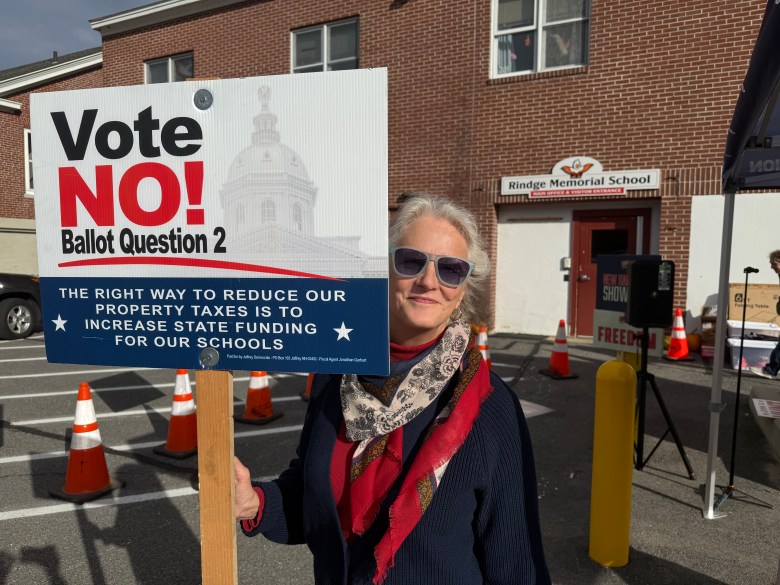
Voters on both sides of the issue spoke about their views on the tax cap at the polls on Tuesday.
Jaffrey-Rindge Cooperative School District voters passsed the 60% threshold by a mere 12 votes district-wide.
Voters in both towns approved the ballot question, though it was closer in Jaffrey, with 1,267 yes votes to 1,122 no. Rindge voters were more decisively in favor of a cap, with 1,821 yes votes to 918 no, almost a 2-1 margin.
In total, 3,088 votes were counted as “yes” across the district. Given the number of ballots cast, 3,076 votes became the number needed to reach the 60% threshold needed to pass the cap.
Bob Meissner of Jaffrey, who was supporting Democratic candidates on Tuesday, said he voted “no.”
“I did vote no, because the unintended consequences of making a cap like that are that there are areas that need to be funded that that cap would eliminate the possibility of funding — important items for the school and the school district,” said Meissner.
Students rally against cap
While the Mascenic School District did not reach the 60% majority needed to pass the cap, it was a close contest, with a dead tie in Greenville, and a majority in New Ipswich approving the measure.
Greenville voters were evenly split on the issue, with 348 votes both for and against the ballot question. In New Ipswich, 1,340 people voted yes, compared to 1,167 no.
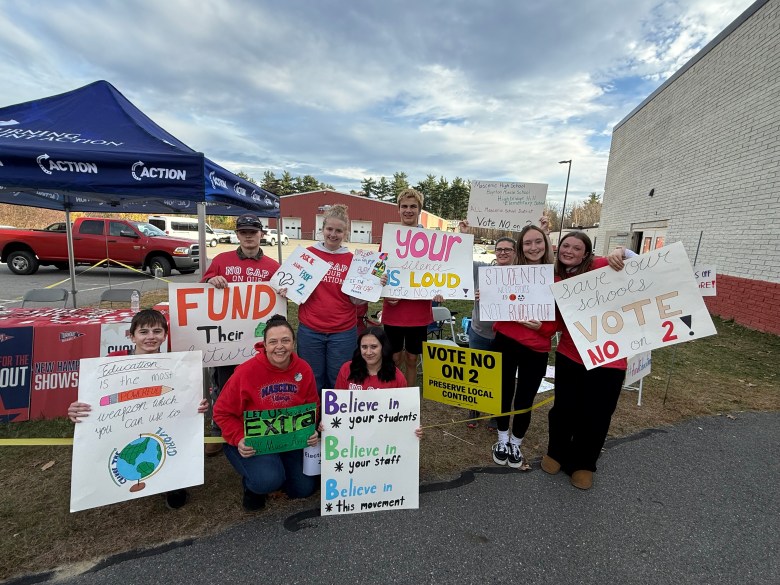
At the New Ipswich polls on Tuesday, the entrance to the polls at the Mascenic gym was lined with students, wearing custom t-shirts in Mascenic Viking colors, and holding hand-made signs declaring “Fund their future,” and “Your silence is loud, vote NO on 2!”
The group was organized by students Isabella Ratliff and Logan Morrill, both of New Ipswich, who were at the polls on Tuesday talking to voters about the cap and encouraging them to vote no.
“I think we’re making a pretty big impact,” Ratliff said at the polls Tuesday. “We’ve been talking to people before they go into the polls and vote, and telling them how this is affecting us personally, as students. And it’s really changing minds.”
Morrill said that several people told him they were impressed that students had made an effort to rally on the issue.
ConVal rejects cap
In ConVal, the district failed to reach the 60% majority to pass the cap; most towns had majority support.
A notable outlier in that trend was Peterborough, where 1,647 said yes to a cap, compared to 1,867 no. Dublin also had a majority “no” vote, by only one vote, with 420 yes to 421 no. The rest of the towns showed majority support.
Irena Rose of Peterborough was one of those who voted “no” at the polls on Tuesday on the tax cap question, saying, “I’m for supporting the school whenever I can.”
Michael Gonzalez of Peterborough, freshly turned 18, voted for the first time and said he supported the cap. He said that while he doesn’t yet have a property tax bill, he’s seen the pressure put on his parents and family friends by increased property taxes.
Tight vote in Wilton-Lyndeborough
While it ultimately failed, the vote in Wilton and Lyndeborough was just three votes shy of the 60% approval rate needed to pass.
Voters in both towns had a majority in favor the tax cap. In Wilton, 1,102 people voted yes to 759 no, a margin of 59%. In Lyndeborough, 524 voted yes to 331 no, a margin of 61%.
In order to reach a 60% majority, 1,629 yes votes were needed.
In Lyndeborough, several citizens who were there to vote said they were in favor of the cap — on both sides of the aisle.
Phil Weigale of Lyndeborough, who voted Republican up and down the ballot on Tuesday, said he was in support.
“Somebody’s got to do something; maybe it’ll open up some dialogue,” Weigale said.
Caroline Pierce, who voted Democrat on Tuesday, called the cap a “good place to start.”
“We need to get some legislation in to get some control,” said Pierce.
Married couple Dan and Carol Wolfson of Lyndeborough, who supported mostly Democratic candidates, but also in support of current Republican Governor Kelly Ayotte, also said they were in support of the cap.
“He’s retired now, and that really affects us,” said Carol Wolfson, about her husband and rising property taxes.
Tax cap fails with majority support in Mason
In Mason, most voters supported the tax cap, but it ultimately fell short of the 60% supermajority needed to pass.
At the polls Tuesday, 412 said yes to the cap, and 330 said no, or a 55.5% approval rating. The measure would have needed 445 yes votes to pass.