


With the November general election approaching, residents heard from local House of Representatives, State Senate, and Executive Council candidates on education funding, housing affordability, and tax policy at a candidates’ forum at Franklin Pierce University on Tuesday night.
Franklin Pierce University, the Monadnock Ledger-Transcript, and the League of Women Voters co-hosted the forum.
Executive council: Oversight and federal grants
Incumbent Democrat Karen Liot Hill of Lebanon faces Republican Tobin Menard of Newport for the Executive Council District 2 seat. Candidates for District 5 — incumbent Republican David Wheeler and Democrat Melanie Levesque — were unable to attend due to prior commitments.
The five-member Executive Council approves state contracts over $10,000 and confirms high-level appointments, including judges, and oversees state spending.
Addressing recent ethics violations surrounding former state Supreme Court Chief Justice Gordon MacDonald, said that, when affirming judge appointments, it was important to him to know judges had “followed the law” rather than a party line in prior bench decisions. Liot Hill said she was deeply concerned about the current situation with the chief justice and the implications of three other Supreme Court justices being involved. Over the last month, she said, she has pressed the Judicial Conduct Committee on whether the investigation has continued, and the attorney general on whether it’s appropriate to keep arguing cases before the “compromised” Supreme Court.
“I think that the public has a right to know what’s going on and we have unresolved questions that deserve to be answered,” said Liot Hill.
On federal funding, Menard said the council should “look at strings attached,” saying that accepting federal funds could “tie the state’s hands” because of the conditions attached. Liot Hill said the council is leaving federal funds on the table by “needlessly” bringing partisan politics to the table. She pointed to members of the council voting down Planned Parenthood funding and funds for childcare professional development because the grant included the word “inclusive.”
Liot Hill previously served 20 years on the Lebanon City Council and a term as mayor. Menard is an Air Force veteran and has served on several local committees in Newport, including the Library Board of Trustees and the Planning Board.
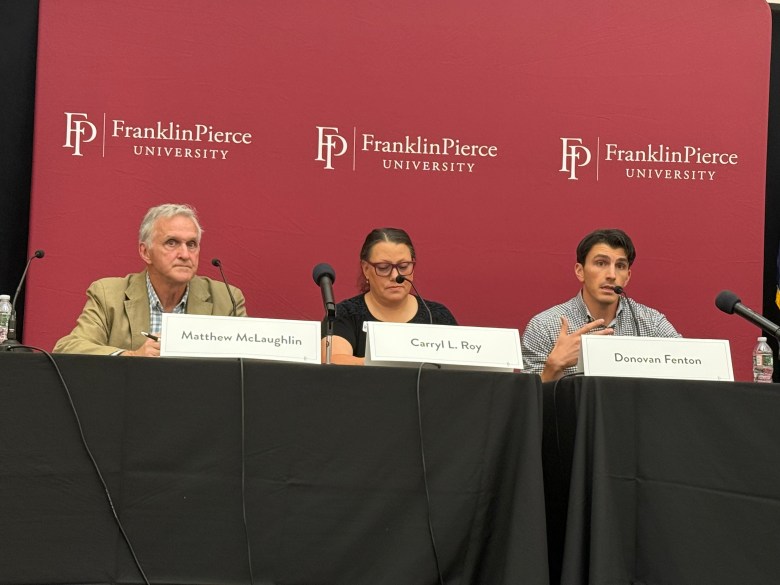
State Senate: Education and local control
Democratic Senate candidates Matthew McLaughlin (District 9) and Carryl Roy (District 12) joined unopposed District 10 incumbent Donovan Fenton (D-Keene) to outline legislative priorities. Incumbent Republicans Denise Ricciardi (District 9) and Kevin Avard (District 12) could not attend.
All three candidates opposed state-mandated ballot questions concerning municipal school budget caps. Roy argued that strict caps undermine mandatory school services like special education. “It is an absolute no for me, because it will damage schools,” said Roy.
McLaughlin noted that local towns already retain the authority to debate and vote on budget limits during traditional Town Meetings. “Those who wanted it, they could pass it,” said McLaughlin. He said putting the question on the November ballot removed the possibility of discussion and debate.
Regarding local law enforcement, candidates largely opposed police participation in federal 287(g) immigration enforcement agreements with Immigration and Customs Enforcement (ICE), contending that federal authorities should handle federal immigration duties without straining local police budgets.
McLaughlin said he would support a ban on such agreements, arguing that local police departments are not responsible for immigration enforcement.
Roy said ICE is a federal agency and that federal agencies should handle those duties, adding that the agreements can damage the relationship between the community and public safety officers.
Fenton said one issue is that the agreement includes training and funding, and many New Hampshire police departments are stretched very thin. He agreed that ICE “is a federal agency; federal agents should handle it.”
Candidates said they supported local control and regulation of future data centers in the state.
McLaughlin called data centers the new big industry of the 21st Century, but said guardrails were needed on purchasing power and water use, and supported local control of siting.
Roy echoed those sentiments, saying, “Communities need to have a say.” She said noise and setback requirements needed to be considered, too. She said being proactive about requirements before data centers were built was key.
Fenton said the Senate put together what he called a “guardrail” bill on data centers, but it ultimately died, and he hoped to see it back before the legislature in the new session.
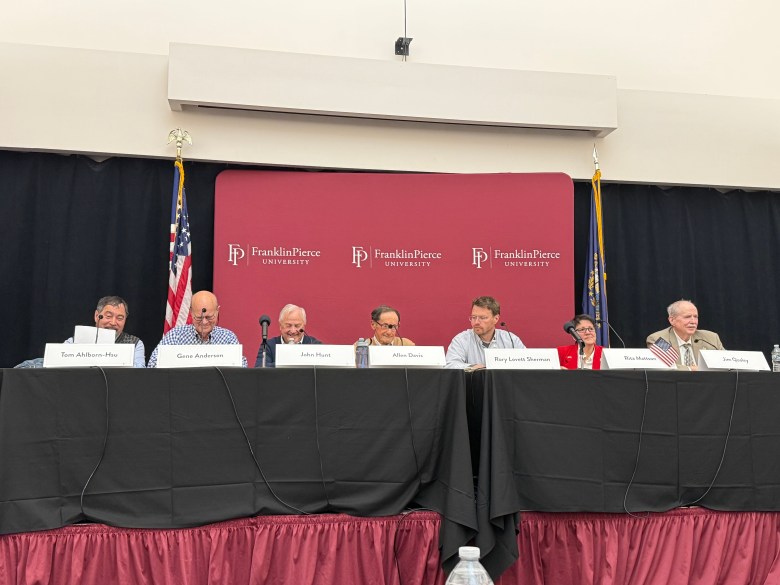
House of Representatives: Housing and school taxes
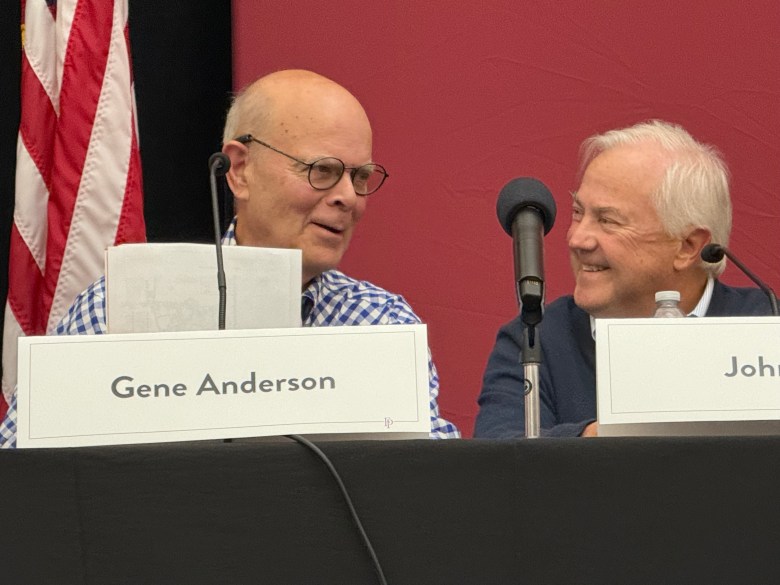
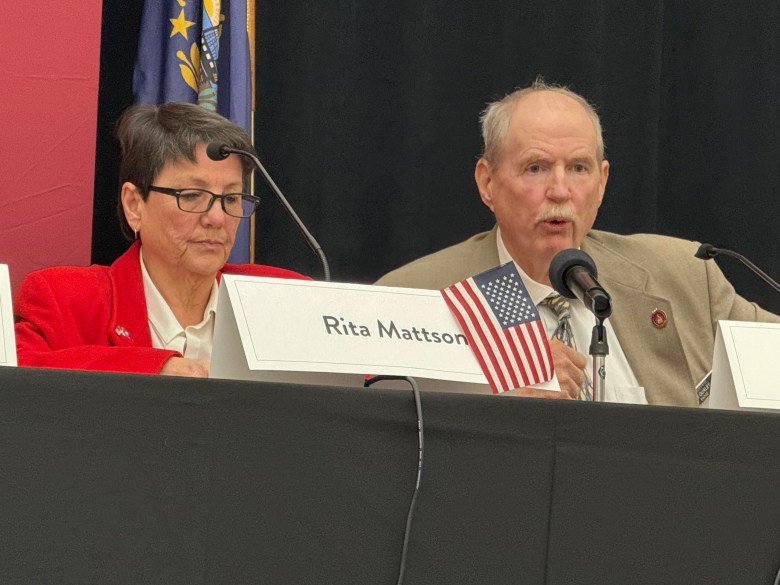
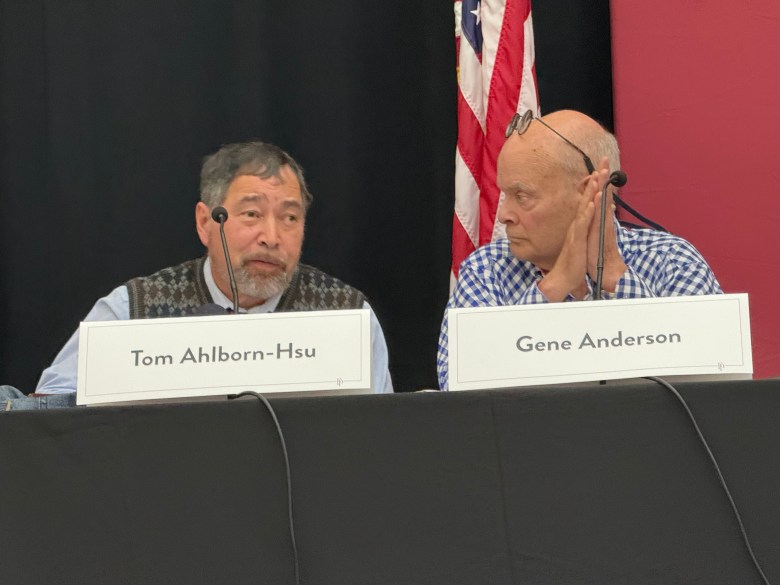
Seven House of Representatives candidates attended the forum, including all four candidates for Cheshire District 18’s two seats: Republican incumbents Rita Mattson and Jim Qualey, and Democratic challengers Allen Davis and Rory Sherman; both candidates for Cheshire District 14, Republican incumbent John Hunt and Democratic challenger Gene Andersen; and the Democratic candidate for Cheshire District 13, Tom Ahlborn-Hsu. Matthew Santonastaso, the Republican incumbent for Cheshire 13, could not attend.
School funding remained a topic among the House candidates. Mattson and Qualey supported putting the school funding question on November’s ballot. Mattson said school administration funding is “out of control,” with costs rising as the student population declines.
Qualey said the ballot question is an “important step” and will draw much higher voter turnout than the March town elections.
Davis and Sherman criticized New Hampshire’s low ranking in state-level school funding, with Davis advocating a partial reversal of tax cuts for high earners to bolster local state aid.
“I think the state’s role should be stop being 50th in the nation,” said Sherman.
Davis said tax cuts on the wealthy have drained state revenue, and that some of those cuts needed to be reversed.
Hunt said there had once been a more robust Statewide Education Property Tax, or SWEPT. He said the state eventually “kowtow”ed to larger, more affluent cities that didn’t want to be “donor” towns providing an equal education to more rural areas.
“We do have a way to make property tax reasonable,” said Hunt, speaking of SWEPT.
On housing, Ahlborn-Hsu noted that one of the biggest barriers to affordable housing in the state is the cost of goods, which he said tariffs are affecting. He said the state also needs to change how it views tax abatements, suggesting rent subsidies and property tax abatements for those in need instead of tax breaks for big businesses.
Anderson pointed to the state’s mandates around town zoning related to Accessory Dwelling Units, or ADUs, saying it’s made a real difference. He said there may be other ways to address the housing issue through building code. Davis also said he supported creative zoning solutions such as ADUs, and cluster housing.
Hunt said the problem lies not with the legislature but closer to home, saying that “Not in my backyard”-ism has made planning and zoning unfriendly to housing, and urged people to use their planning and zoning elections to make their priorities clear. Sherman agreed, saying towns should set their own regulations, but they should also have state resources for things like environmental assessments and protections, and that as costs rise, it shouldn’t be left entirely to developers.
Mattson said new stock wasn’t the only solution, and that loans for “fixer-upper” homes should be more available. Qualey said housing is a national issue with no single fix, but the state should avoid “over-regulation” and keep taxes and regulatory burdens low to attract and retain residents.
On marijuana legalization, Mattson and Qualey voiced strong opposition, citing public safety concerns and a lack of reliable roadside sobriety testing.
“I am absolutely against legalizing marijuana,” said Mattson.
Conversely, Hunt and attending Democratic candidates supported regulated, taxed adult-use legalization similar to state control over liquor sales.