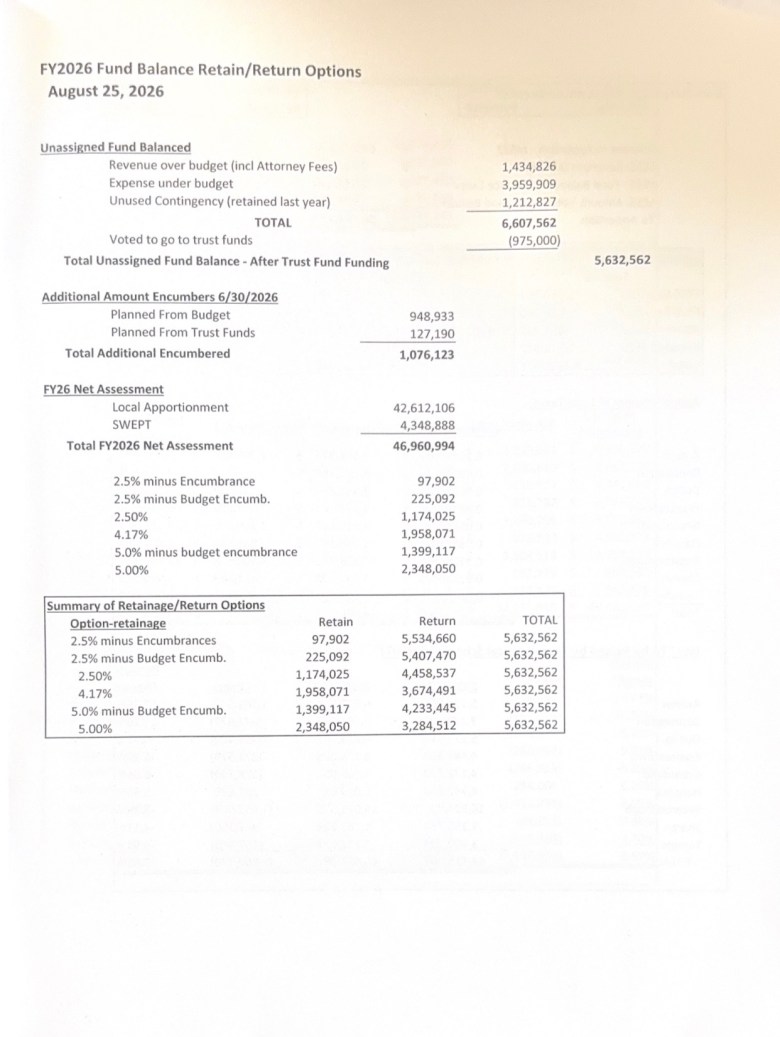
The Contoocook Valley School Board faces a decision between returning a larger amount of money to taxpayers, for a tax drop of about $5.5 million, or buffering against a looming budget spike next year.
The vote will decide how much money the district has in retention, meaning the amount of the district’s end-of-year unassigned general funds in reserve. The district’s policy limits this fund to 2.5% of the total budget, with the remainder offsetting property taxes.
Unlike in past years, the board has to factor in the additional encumbered funds it saved in late June as a precaution against House Bill 1610, which Gov. Kelly Ayotte eventually vetoed.
At the time, HB 1610 proposed retroactively changing the requirements around school districts’ ability to retain unspent funds, requiring districts to vote annually on whether to allow retention of end-of-year unassigned general funds, reducing the maximum retention limit from 5.0% to 3.5%, and restricting how the funds may be expended.
On June 29, the board encumbered $1,076,123 with an additional amendment: if HB 1610 failed to become law, the encumbered funds would automatically reduce the district’s allowable 2.5% retention cap by an equal amount.
Now, the board must choose whether to follow the policy or waive the amendment.
The two main arguments support a 2.5% retainage minus the encumbrances, which follows the policy, or a 2.5% retainage, which requires a waiver of the amendment.
Before they make their decisions, ConVal District Business Administrator Neil Cass told the board to consider how this rate will influence next year’s tax rate and future years. He also reminded members of the board that the Francestown withdrawal could result in approximately a $3 million cut from the budget if there’s no tuition intake, as well as the proposed tax cap on the ballot at the general election in November.
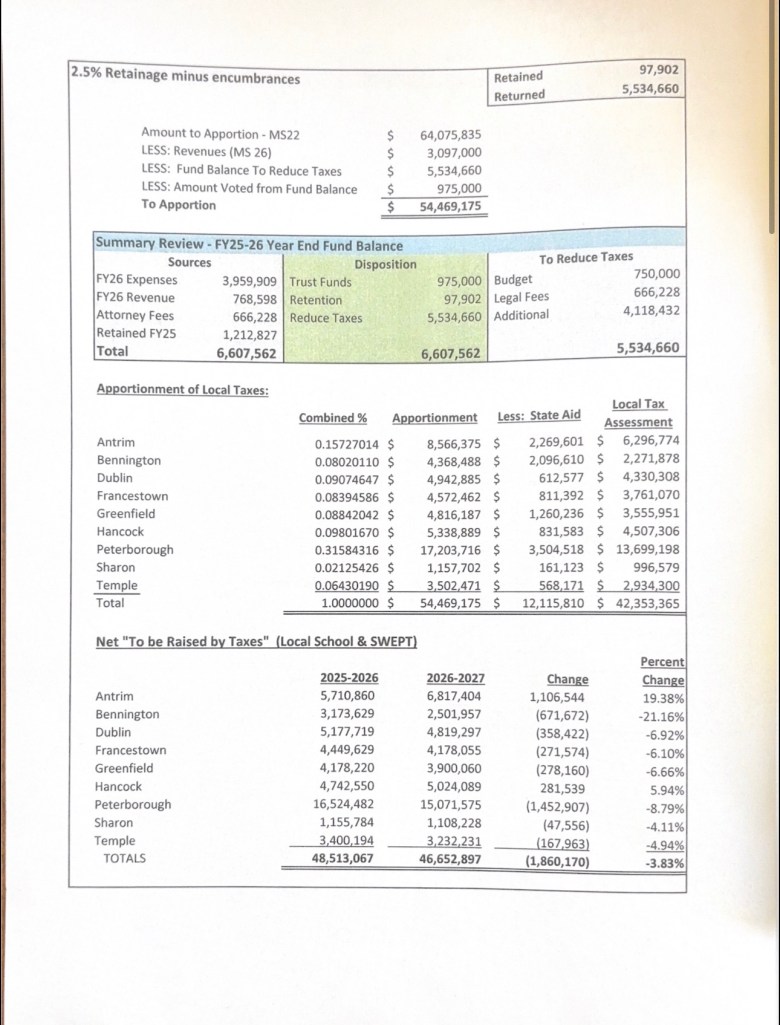
Jim Kingston, representative of Temple, strongly supports following the policy and returning $5,534,660 to offset the taxes.
“There is no scenario under a condition of declining enrollment and the accompanying decline of state dollars coming into the school and an increasing budget due to inflation, where giving as much money to the taxpayer upfront doesn’t save them money in the end,” Kingston said.
Cass noted that this decision would lead to a dip in taxes this year, but taxpayers should expect a large increase the following year due to Francestown’s withdrawal.
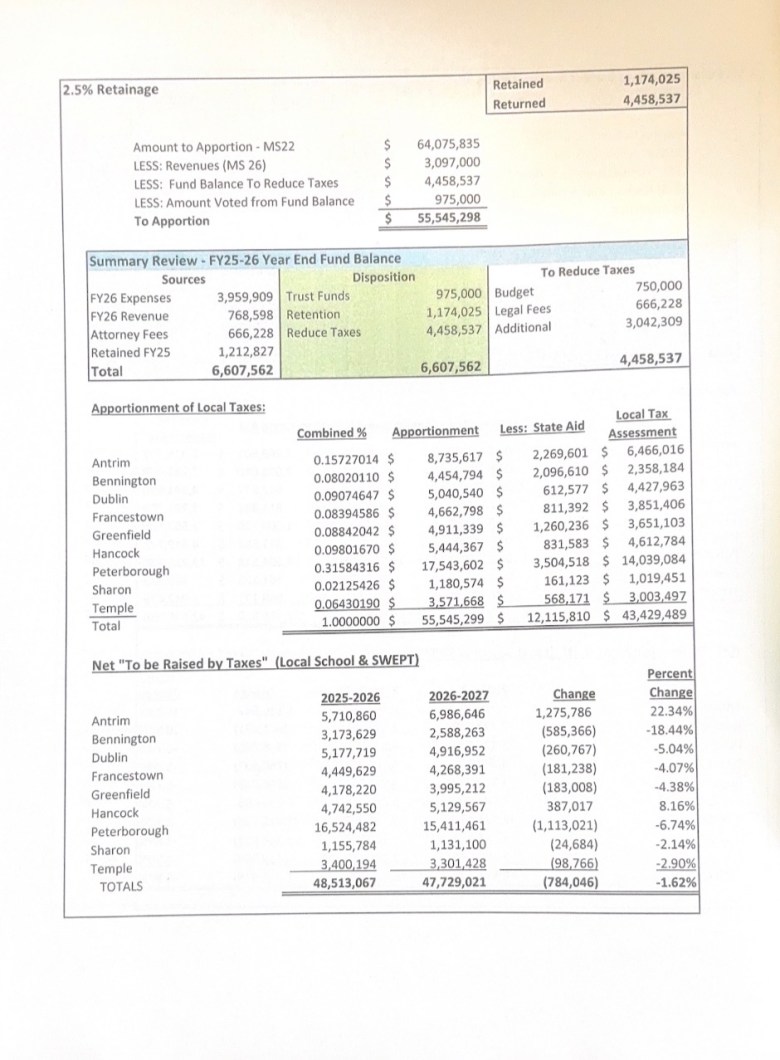
The board members advocating for level taxes supported the 2.5% retainage, returning $4,458,537 to offset taxes.
Compared to last year, the 2.5% retainage minus encumbrances would mean taxpayers are paying 3.83% less than the year before, whereas the 2.5% retainage would mean taxpayers are paying 1.62% less than the year before.
Either way, this means taxpayers are paying less, but it is not sustainable for next year with Francestown leaving the district, according to Cass.
Other board members shared their concerns about the unknown impacts of the tax cap.
“We have to make sure that we have taken care of the fact that we will have real expenses that will be rising, so we don’t have to cut into programs and staff,” Janine Lesser, Peterborough representative, said.
Kingston argued that tax caps proposed by residents in the past have failed.
In response, Elizabeth Ahearn, Peterborough representative, explained the tax cap would be voted on at the general election in November, not the school board election in March, as in past years.
In the 2022 general election, 3,346 people voted in Peterborough, according to the NHPR database. Ahearn pointed out that fewer than 1,000 Peterborough voters usually participate in school board elections.
“That is a dramatically large turnout. It’s a different voting population,” Ahearn said.
With the discussion ongoing, the board plans to vote on this issue at the next meeting on Sept. 1.