

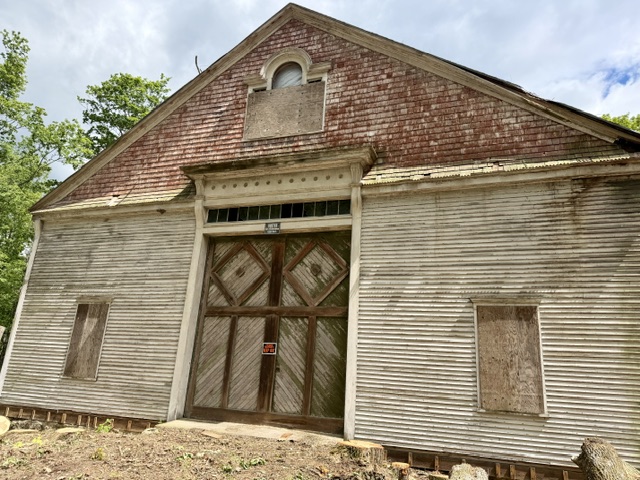
An abandoned house and barn on Route 101 in Dublin have spooked generations of Granite Staters, who whisper of an untimely death and a curse on the land. But after a neighbor bought the property in December, the real story finally came to light.
“What I can’t understand for the life of me is how the person who owned that could neglect it so badly. … It’s house abuse,” Olga Davidson Nagy, the home’s new owner, said.
History of the mystery house: 1880s-1970s
The popular story told in neighboring towns or online is the story Nagy and Wes Aldrich, her son-in-law, knew as well.
The theory goes something like this: A man built the home and barn for his child and their fiancé as a wedding present. While on their honeymoon, the couple died in a plane crash, leaving the father heartbroken and the house empty.
While this is entertaining, the reality seems much more complicated and less drastic, but still involves some family drama.
Based on information from the Dublin Historical Society and a descendant of the family who owned the property, Elise Grant, the real story starts with Richard T. Parker in the 1880s.
Built in the 1880s, the property’s first owner was Richard T. Parker, a well-off Bostonian who visited Dublin to see his friend Gen. Caspar C. Crowninshield, a fellow Bostonian and supporter of the original construction of the Dublin Town Hall.
Parker lived in the large summer house behind the property, while Benjamin Willard, the farmer for the Parker estate, stayed in the home next to the barn from the 1880s to 1910.
Eventually, the whole property was sold to Daniel Catlin, who tore down Parker’s summer house.
In the 1930s, Catlin hired Richard Wigglesworth, an architect from Boston, to update the property located on what is now Route 101.

At that point, neoclassical features were added to the barn, including a round-topped octagonal cupola with classical columns, an arched entrance and a full-height, round-arched Palladian studio window, described as cathedral-like in a report by the Dublin Historical Society.
Catlin intended to gift the barn as a summer studio to his nephew-in-law, Thomas Blagden, but Blagden barely used it, according to the Dublin Historical Society.
Elise’s memories
The Dublin Historical Society’s records lead up to Elise Grant’s personal experience living near the property.
Grant’s mother, Irene Grant, whose father was Daniel Catlin, was gifted the large house behind the now-popular abandoned property, as well as the house and barn, after her parents died in the 1970s.
“The Big House,” as Grant describes it, is located next to her home and was given to her aunt, Martha Blagden, who eventually sold it to Olga Davidson Nagy.
As Grant describes it, when her mother was young, the house was home to a grounds caretaker and the barn was full of hay.
“The kids, when they were younger, used to play and then jump in the hay. They used to go in there all the time,” Grant said.
Grant said the family lived in St. Louis, Missouri, but visited the properties for four months each summer.
When her mother was gifted the property, Grant said her oldest brother, Benton Grant, or “Benny,” asked for it.
According to property records, the house and barn were given to Benton in 1979.
“It’s the stupidest thing she ever did,” Grant said.
After Benton took ownership, nothing was done to the property until now. For about 47 years, the house and barn went untouched.
“It just broke my heart, just to see this place fall down the way it did,” Grant said. Her current home, formerly owned by her mother, has a clear view of the deserted property.

Even when approached by multiple residents, Benton refused any free help to fix up the place, Grant said.
“I just couldn’t stand it. I was furious,” she said.
So the house stood through vandalism, storms and abandonment until Benton died last year.
A new era
Soon after Benton’s death, Nagy ran into her neighbor Grant and learned the property was for sale. She called the real estate agent right away.
“I did everything within an hour to tell them how serious I was about getting this,” Nagy said.
After 61 right-of-first-refusal signatures and a large payment, the land was hers.
Nagy set out to buy the house and barn as a form of protection for her family’s houses behind it on 27 Stonlea Lane.
“This additional place was, in my eyes, protection, but then it was also a wonderful thing of how much fun it would be to fix it,” she said.
Since December, that’s exactly what Wes Aldrich and his friends have done.
Aldrich has extensive experience with construction, working with his father in Greenfield and then in historical restoration and reconstruction.
“I’ve always loved post-and-beam stuff,” he said.
He also works as a full-time musician, playing in the band Hug the Dog.
Aldrich has been working to restore the house and barn with his musician friends, who also work in construction.
He said he understands the public’s interest given the property’s legacy.
“It’s generational; my parents have driven by their whole lives … I haven’t met anybody who remembers it when it was in use,” he said, despite his neighbor Grant living a few doors down.
Future of 779 Main St.
Nagy and Aldrich said the dangers on the property outweigh the curiosity of locals, including this reporter.
“We do have to say that it’s incredibly dangerous to go down there now, so you’ll just have to take our word for it,” Nagy said.

Large doors entering the abandoned barn in Dublin. Credit: Wes Aldrich 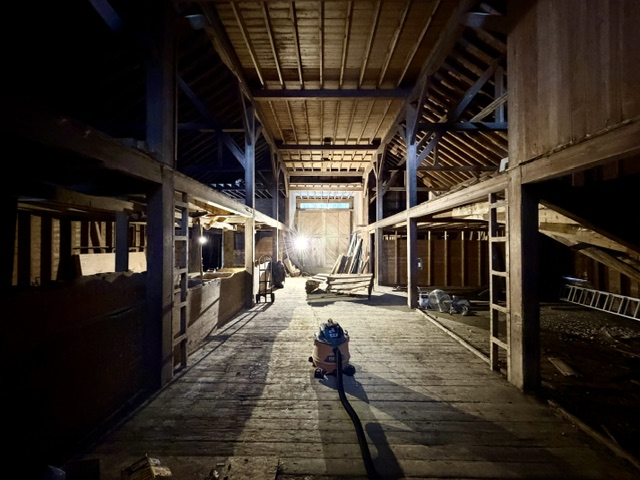
A look inside the abandoned barn showcasing the stalls with animal chew marks. Credit: Wes Aldrich 
The extravagant inside the old barn in Dublin. Credit: Wes Aldrich 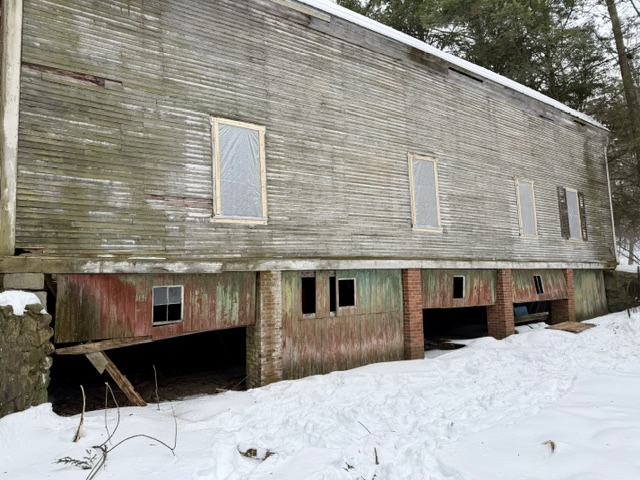
Side of the abandoned barn in the winter soon after Olga Davidson Nagy purchased the property. Credit: Wes Aldrich
Aldrich described a chestnut-and-Douglas-fir wood frame for the barn with “Beacon Street” stamped throughout the lumber. He also said the cupola is full of initials carved into the wood.
Nagy originally wanted to move the barn back from the road, but after learning the foundation was pegged together, she changed her mind.
“No way. Those pegs stay,” she said.
Nagy described large stalls with chew marks in the wood inside the barn. The team found large, broken and out-of-place windows there — possibly the former cathedral-like windows refurbished by Grant’s great-grandfather, Daniel Catlin, according to the Dublin Historical Society.
Over the years, the interior doors and fireplace mantels had been stolen, Aldrich said.
The house, on the other hand, has never had water or electricity, and Nagy described the walls as extremely narrow and small.
“The house is virgin territory,” Nagy said.
Aldrich started construction by removing trees along Route 101 that were growing into the foundation.
As for the rest of their plans, the goal is to keep the barn and house the same. Aldrich wants to renovate the house to make it livable, and Nagy said she wants to keep the character, including the chimney located in the middle of the home.
“I think we’re really just gonna renovate it back to what it was,” Aldrich said.
The family is not new to renovating older homes. On their property alone, they have refurbished at least three houses to protect their history and make them livable.
“The only thing we’re going to do is put the whole focus instead of on the road, up on the field, because that meadow is beautiful,” Nagy said.
Down the road, Nagy said they plan to donate the swap area for conservation land.
The construction timeline is uncertain given the unknown condition of the property, but Aldrich said he hopes to finish by next summer.
He said the whole foundation needs to be fixed and that he plans to secure all permits before starting each project.
While the history of the house and barn has been exposed, the future of the property remains unknown.
In the end, Grant said she feels relieved the project is in her neighbor Nagy’s hands.